The Human Element

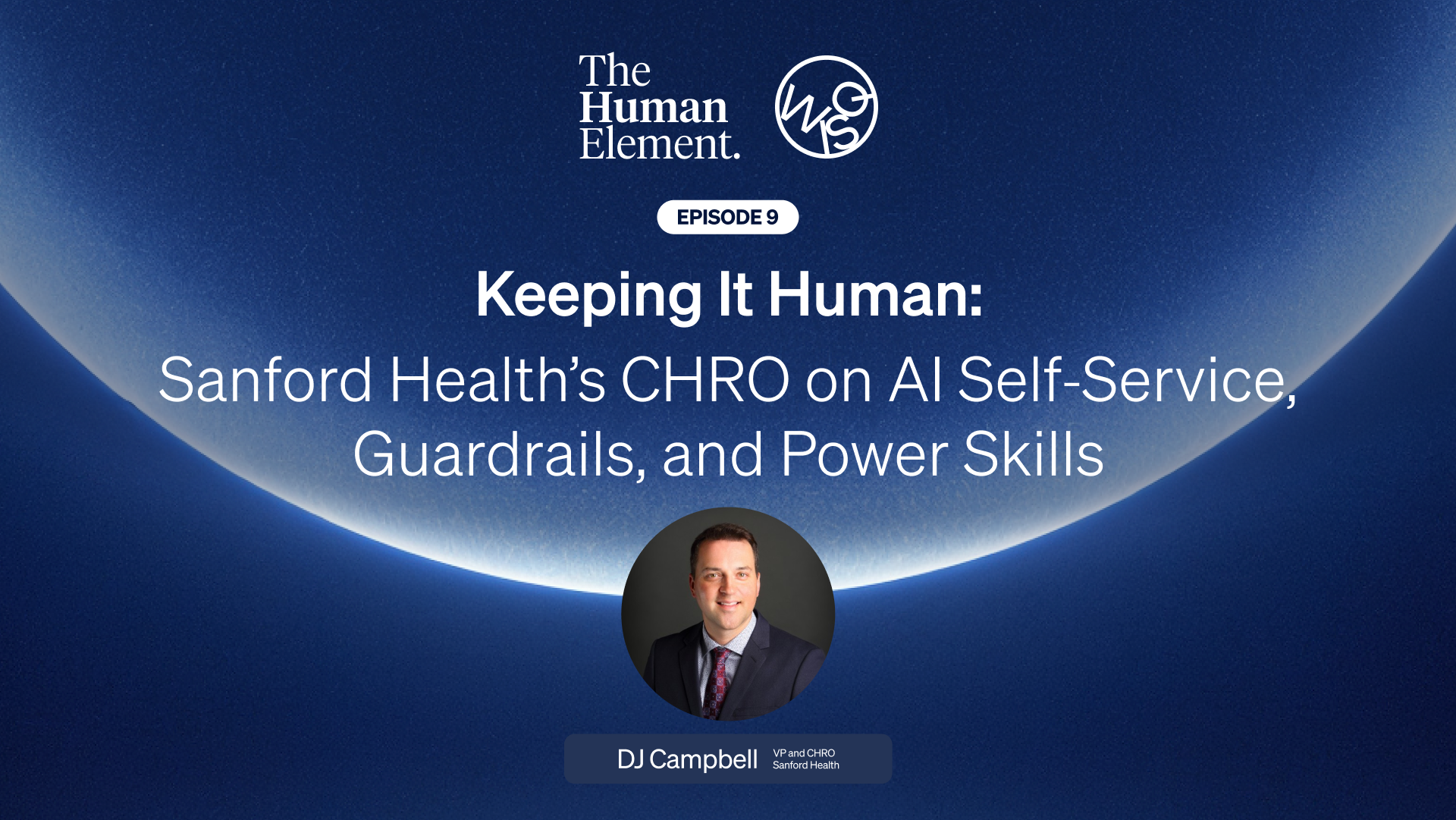
The Human Element Episode 9: Keeping It Human with Sanford Health
Learn how Sanford Health’s CHRO uses AI self-service, guardrails, and power skills to reduce friction for a 24/7 workforce while keeping HR human.
How do you deliver human-centered HR support to a 24/7 workforce spread across one of the nation's largest rural health systems?
In this episode of The Human Element, DJ Campbell, MBA, SHRM-SCP—Vice President and Chief Human Resources Officer at Sanford Health’s Bismarck market—shares how AI self-service can cut friction for a 60,000-employee system while keeping the experience unmistakably human.
Sanford Health is the largest rural health system in the United States, serving more than one million patients and 220,000 health plan members across 250,000 square miles. With a mission to transform the health care experience in America’s heartland, DJ brings a grounded, operational view of what AI can and cannot do across a complex clinical enterprise.
He outlines what must be true before greenlighting tools—readiness, education, and myth-busting—and how to run a focused 90-day pilot that actually proves value. DJ also explains the cross-functional table needed in healthcare (HR, IT, legal, clinical), the guardrails that are non-negotiable (HIPAA-grade security, governance), and the integrations that make or break adoption (HRIS, ticketing).
He goes deeper into reskilling without layoffs through attrition planning, individualized development, and elevating “soft skills” to “power skills.” Expect specifics on measuring ROI and employee sentiment, where AI fits first (think performance management and coding), and why leaders should “be curious, not judgmental” as they guide teams through AI-driven change.
Watch the full interview below.
Key Takeaways
- Start with one high-friction self-service use case (e.g., benefits, requisitions, performance) and pilot with early adopters who will give actionable feedback.
- Build readiness first: educate on what AI is/isn’t, debunk myths, and position AI as support—not replacement—while recruiting informal influencers in every department.
- Measure what matters: track usage and time saved, then add targeted engagement-survey items to diagnose adoption barriers and iterate.
- Plan reskilling through attrition: map retirements/turnover, redesign roles, and fund individual development—especially for coding-adjacent functions.
- Elevate “power skills” (communication, listening, EQ) as the leadership differentiators in an AI-enabled workplace.
- Demand healthcare-grade guardrails: HIPAA-level security, AI governance, and seamless integrations with HRIS and ticketing from day one.
Key Timestamps
[01:21] – Why AI self-service for a 24/7 workforce; top employee pain points
[05:02] – What must be true to greenlight AI: readiness, education, and cross-functional buy-in
[07:42] – Designing a 90-day pilot: start with one use case and early adopters
[10:09] – Keeping it human: myth-busting, informal influencers, reassurance not replacement
[12:42] – Measuring adoption: usage, time saved, and smart feedback loops
[15:18] – Reskilling without layoffs: attrition planning, coding, and “power skills”
[18:53] – Guardrails and vendors: HIPAA-grade security, governance, and must-have integrations
[23:43] – Lightning round: automate performance reviews, 2026 metrics, leader advice
Full Transcript
Barb (00:46)
Welcome to the Human Element presented by WISC, where we explore how AI and human insight are reshaping leadership and the future of HR. Today, my guest is DJ Campbell. DJ is the vice president and chief HR officer at Sanford Health, where he is leading people's strategy for the Bismarck market and a workforce of roughly 3,800 team members. As a seasoned healthcare HR executive, a board chair, executive coach, and a talent architect, he focuses on workforce and leadership development, talent strategy, and the intersection of technology and people in healthcare. DJ is a frequent industry podcast guest on topics like AI, staffing, and the future of work. It is so great to have you joining me today. DJ, I'm looking forward to talking.
DJ Campbell (01:38)
Thank you, Barb. It's exciting to be here and thank you for the warm introduction. I really appreciate it.
Barb (01:43)
I feel like with Thanksgiving rapidly approaching, we're sort of starting to think about next year. So if I kind of push you to 2026 vision, what problem should AI-enabled HR self-service assistants solve for your team members next year?
DJ Campbell (02:06)
There's so many answers to that question because I think there's so many problems in the current systems that we're utilizing from a technology standpoint. And there's just a ton of pain points out there. Whether it's creating a more productive and efficient system—for HR our customers are typically our employees—so making sure that they have the time, resources, and energy to save time and get the answers that they need, and streamlining our processes at a department level.
Right now, I think most self-serve centers either utilize a text feature or a call-in center, so those take manpower. I think there's a more efficient way with AI being implemented and integrated so people can get their answers more quickly and efficiently, so they can get back to doing what, especially in healthcare, we want them to do, which is taking care of our patients.
Barb (03:00)
Totally. What kind of pain points are you hearing from your team today that they would love to see an AI self-serve assistant solve for them next year?
DJ Campbell (03:09)
We have nearly 60,000 employees across all of the different businesses we have. One of the big pain points is: How do you find all the necessary information you need to make good decisions in a practical time pattern? Often you're looking for those answers after hours, which means getting special access into the intranet, into the system, into whatever platform has the information.
If you're looking at a benefit selection or understanding how a benefit supports you, you're probably going to want to go through that with your loved ones. Being able to have AI integrated into that process—where you can type a question and get directed to the right resource—is critical. Whether it's benefits, creating a requisition for talent acquisition, or helping move a process along, all of those functions take time and energy. AI helps create productivity and efficiency and gets answers to the frontline people who are taking care of our patients.
Barb (04:27)
Totally—and when they need it, right? Like you said, you're running a 24/7 operation. I have global teams in my world, and it's not at 1 p.m. on a Tuesday that managers or team members always need you. When they have questions, it can be anytime. Life is better for everyone when answers are accessible instantly through an agent or assistant.
DJ Campbell (05:06)
Absolutely. Anytime we have to wait on technology or search for answers, it's a moment of frustration. The more efficient we can make that process, the less stress people have in their lives.
Barb (05:22)
So talking about where you and your team are now—exploring, budgeting, piloting—what must be true before you greenlight a solution?
DJ Campbell (05:42)
That depends on the solution. We're piloting some clinically based AI solutions that have real return on investment in terms of efficiency, time, and standard of care. Those go first because they directly help our patients.
When we look at something like an HR AI assistant, the first thing is making sure our customers—our employees—and our teams are ready for that. Internal readiness is essential: Do they have the knowledge to understand AI and how it supports them?
I haven't talked to anyone who says AI can help others' work but not theirs. The reality is it's going to affect all of us. We need to support our teams through a monumental shift over the next five to ten years as AI becomes more advanced and capable. Think about autonomous cars—years ago, I thought no way in my lifetime. Now I've ridden in one. It's cool and scary.
So readiness and education are critical. Yes, AI will take on some tasks. But it's not replacing you as a human.
Barb (07:42)
It's building that foundation of trusted use. People need to understand AI isn’t intended to replace them—it’s meant to make life easier. Without that understanding, any pilot will fall flat. If you were looking at a 90-day pilot, what would that look like for you?
DJ Campbell (08:19)
I’d start with one small self-service function—maybe benefits, requisitions, or employee performance management. It’s drilling down into one singular function and finding a decent-sized group to pilot with—early adopters who will give strong feedback and are looking for solutions.
Then it's about identifying those early adopters who can champion the process as we scale it across the organization.
Barb (09:16)
Totally. And I'm curious who you think needs to be at the table when evaluating these technologies—IT, compliance, clinical?
DJ Campbell (09:37)
It has to be everyone. HR, legal, compliance, clinical—AI affects the entire organization. IT has to be represented. We need clear expectations that each representative cascades information to their teams. If you want true organizational change, everyone needs a seat at the table.
Barb (10:21)
Let’s go back to the human element. How will you support people through this transition and keep the solutions human?
DJ Campbell (10:42)
First, we need to give people foundational information: What is AI? Where did it come from? Where is it going? And we need to debunk myths—what AI is not. Whenever you roll out something big that touches every employee, there’s fear. You have to address it head-on.
Next is working with leaders to identify early adopters who will support the change. Often when something is going wrong, people don’t go to their leader—they go to a peer. If we can find informal influencers in every department, that helps immensely.
The biggest elephant in the room: Yes, AI will change how we work, but it will not replace you. Your work is valuable. We have more people retiring than entering the workforce. We need technology to support the gaps. This isn't the first technological shift in history. Hopefully we’ve learned from the past.
Barb (12:58)
Totally. With the pilots you're running, what leading indicators validate adoption and usage?
DJ Campbell (13:13)
Usage is number one. In clinical pilots, we look at usage and efficiencies gained. That will be the same for HR self-service—how many people are using it, and how much time is saved. Then we collect data month over month and compare it to baseline to understand adoption.
Barb (13:56)
If you weren’t seeing adoption, would you go back to readiness?
DJ Campbell (14:11)
Yes—and we’d use our anonymous employee engagement surveys to ask targeted questions. Direct asks don’t always surface the truth; anonymity helps. We'd take the feedback back to early adopters and refine from there.
Barb (15:00)
You talked about reassuring employees around job impact. How are you thinking about upskilling, role redesign, and helping employees move into new opportunities?
DJ Campbell (15:44)
That conversation has to start now. Coding is a clear example—AI is built for it. We look at attrition: retirements, turnover. If staffing reduces over time, that doesn’t have to result in layoffs. We can plan for AI adoption so open roles transition to automated support.
There will be reskilling—certifications, education, professional development. And it's human work: helping each employee understand the plan, identifying early adopters excited to grow, and building individual development plans. There is no one-size-fits-all.
Leaders must be more human-centric than ever.
Barb (17:32)
Absolutely. Are you seeing any reskilling pathways employees are particularly excited about?
DJ Campbell (18:12)
Yes—power skills. Communication, listening, emotional intelligence. In a world of increasing technology and remote work, people crave more interaction. Many want to develop the skills that help them support others. Especially in coding-adjacent areas, people want to be more human-facing.
Barb (19:06)
Let’s talk about guardrails and vendors. What are your non-negotiables?
DJ Campbell (19:31)
Healthcare is a late technology adopter because we're huge and highly regulated. We handle enormous amounts of confidential patient data. So first: security. HIPAA compliance, security risk assessments, governance. We need AI governance and IT governance.
When selecting vendors, we only know what we know. We need consultants and experts. AI isn’t always accurate—it hallucinates—and we need to understand risk mitigation.
Barb (21:16)
What about integrations? Any deal breakers?
DJ Campbell (21:57)
Yes—they must integrate with HRIS and ticketing systems. Many enterprise vendors have some AI, but we need to understand what it actually provides. There are great third-party vendors that integrate well across systems. It's about making all our programs work together.
Barb (22:54)
Integrations have changed drastically in the last five years—so much easier now. Leaders who consolidated systems because integration was hard should revisit that assumption.
DJ Campbell (23:19)
Absolutely. I agree.
Barb (23:22)
Now for the lightning round. What is one HR process in healthcare you’d automate first with AI?
DJ Campbell (23:25)
Performance management. Everyone hates writing evaluations. AI can help document conversations, summarize them, and let leaders focus on real dialogue.
Barb (24:14)
Could not agree more. The value is in the conversation, not the heavy lift. What metric will you watch in 2026 to know AI is helping employees?
DJ Campbell (24:58)
Two metrics: productivity (time saved and reinvested) and survey data. We need employee sentiment about AI adoption.
Barb (25:46)
What’s one piece of advice for HR leaders preparing teams for AI-driven role changes?
DJ Campbell (25:56)
Get back to basics of leadership. Move from managerial to human. Listening, EQ, communication—what we used to call soft skills—these are power skills. They are the differentiators of the future.
Barb (26:37)
So much great content today. My takeaways:
– Put information where people can find it fast.
– Readiness before rollout: myth-busting, clarity, education.
– And power skills—help your teams strengthen what makes them human.
DJ, give us your final advice for leaders starting their AI journey.
DJ Campbell (28:57)
Be curious, not judgmental. That quote gets attributed to Walt Whitman and was made famous again by Ted Lasso. There’s so much information about AI—some true, some not. Leaders should talk to colleagues, industry reps, and ask the right questions. Be curious. Explore. There’s a lot of potential if we have the right people asking the right questions.
Barb (29:43)
This was so fun, DJ. Thank you for sharing your time and wisdom.
DJ Campbell (29:53)
Thank you for having me. It's been great.
Barb (29:55)
Of course.
Related

Learn how Acelero Learning applies AI in HR to scale listening, streamline hiring, and deliver personalized learning paths while keeping people at the center.